
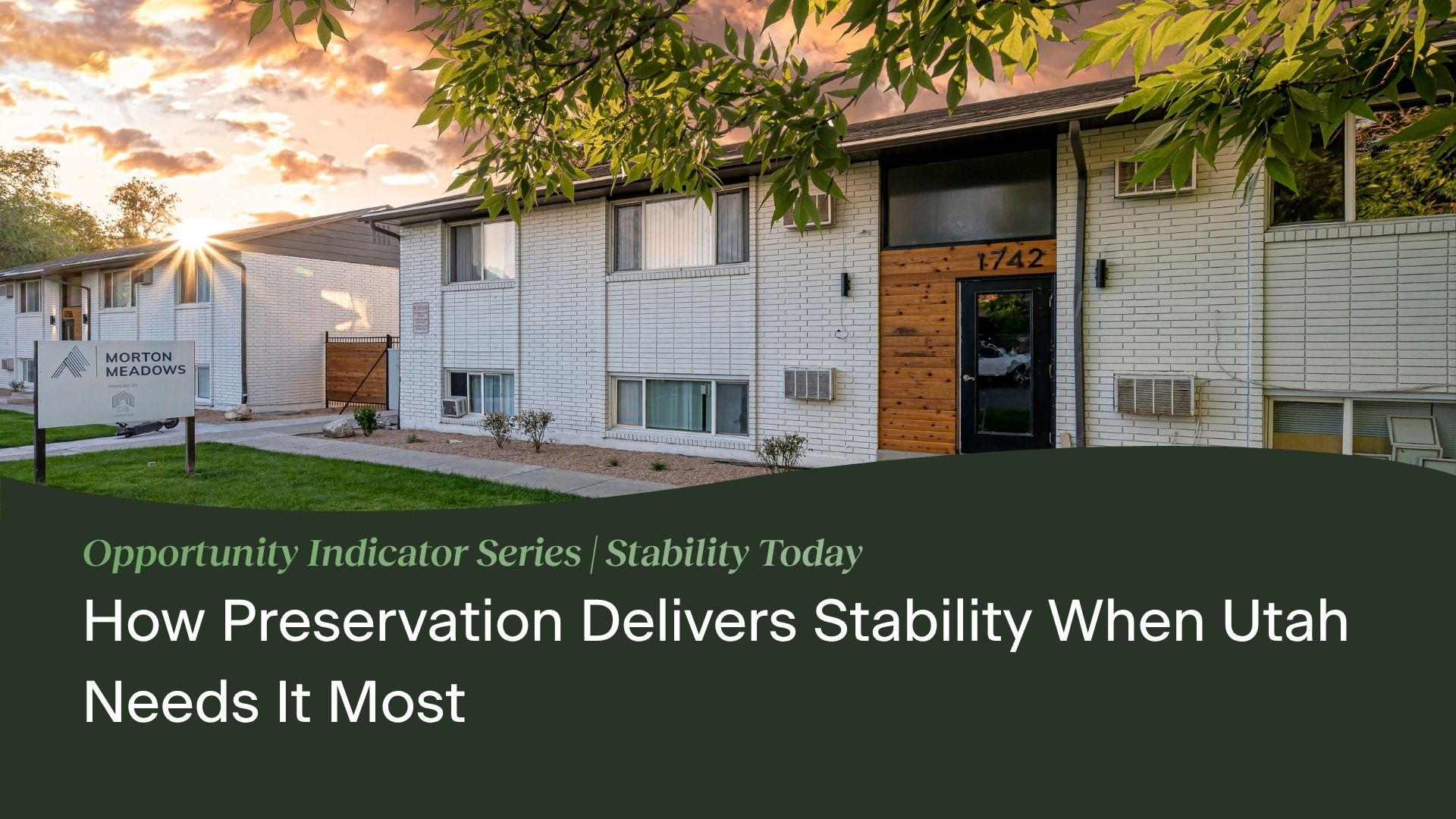
What our resident survey reveals about Housing Stability — the first of three Opportunity Indicators — and why preservation is the fastest answer to Utah’s affordability crisis.
Affordable housing in Utah rarely disappears in a single dramatic moment. There’s no demolition crew, no headline, no warning. It slips away quietly — when a longtime owner decides to sell, when a subsidy expires, when the rent ticks up $300 or $400 a month and a family that has built a life in one place suddenly can’t afford to stay in it.
That quiet kind of loss is exactly what we built the Utah Housing Preservation Fund to stop. And the data from our residents tells us why it matters so much.
Utah is, by almost every measure, thriving. The state leads the nation in economic growth, posting 4.6% real GDP growth against a 2.8% national average, and it has seen net in-migration in 33 of the last 35 years. But that same success is squeezing the people who keep Utah running.
Consider what it now takes to put a roof overhead here. The median home price has climbed to $525,000, and you’d need an income of roughly $140,000 to afford a median-priced home — pricing 87% of renters out of homeownership entirely. For many families, renting isn’t a step toward buying. It’s the long-term plan.
Renting, though, offers less and less relief. 40% of Utah renters are now cost-burdened, spending more than 30% of their income on housing. For low-income renters, the math is brutal: 81% spend more than half of everything they earn just to keep their homes. And the supply that could ease that pressure is shrinking — Utah faces a shortage of more than 37,000 units, and over the past decade the state has lost 42% of its rentals priced under $1,000.
Layer on a projected increase of 240,000 households by 2033, and the gap doesn’t close on its own. As older, lower-cost buildings are bought, renovated, and re-rented at market rates, the most affordable homes vanish first.
This is where preservation does its quiet work. Rather than waiting years for new construction to break ground, preservation acquires and stabilizes existing affordable homes — keeping them affordable now, at roughly 40% less than the cost of building new. The Kem C. Gardner Policy Institute has named preservation a best practice for exactly this reason: it’s faster, it’s cheaper, and it protects the public investment already sunk into these communities.
In other words, the fastest way to solve a housing shortage is to stop losing the housing we already have.
When we surveyed residents across our portfolio, we set out to answer a deceptively simple question: what does preservation actually change in someone’s daily life? The clearest answer is the first of our three Opportunity Indicators — Housing Stability, the ability to stay housed without the constant fear of a rent hike or a forced move.
For many of our residents, that fear is not hypothetical. More than half told us they experienced recurring housing insecurity before moving into a UHPF home — frequently worrying about rising rents or losing their housing altogether. In West Valley communities, that figure climbs above 50%. Even in fast-growing St. George, nearly one in three residents faced chronic instability before they arrived.
Once that pressure lifts, people stay. Residents in our portfolio remain in their homes an average of 4.3 years — nearly twice the national average of 2.3 years, or about 87% longer. That stability isn’t an accident; it’s a direct function of affordability. Today, 48% of our residents spend 30% or less of their income on rent, and across the portfolio, residents save a weighted average of $270 every month. That’s $270 freed up for groceries, medical bills, car repairs, or simply breathing room.
Carolina and Ana Lusisa, property managers at our Hidden Pointe community, see what’s at stake when that cushion disappears:
“If they get an increase of $300–$400, it’d be a really bad impact for them… When their rent is $1,000 and out of nowhere it goes to $1,500 a month, it’s not only rent that it impacts. It impacts the way that they eat, the way that they entertain, pay utilities.”
— Carolina and Ana Lusisa, Property Managers, Hidden Pointe
That ripple effect is the whole point. A stable, affordable home isn’t just shelter — it’s the foundation that makes everything else in a family’s life possible.
Housing Stability is where our mission begins, but it isn’t where it ends. When families stop worrying about whether they can stay, they gain the room to build — to save, to plan, to invest in their own futures and their children’s. That’s the throughline of our work: stability today is what makes opportunity tomorrow possible.
Every home we preserve is a family that doesn’t have to start over. In a market moving as fast as Utah’s, that’s not a small thing. It may be the most important thing of all.
Data drawn from UHPF’s 2025 portfolio-wide resident survey and More Than Housing: 2025 Impact Report. Statewide figures: Kem C. Gardner Policy Institute and the National Low Income Housing Coalition. Learn more at uhpf.org.